

How to Choose a Custom Plastic Fabricator: 7 Things Every Engineer Should Check

I've evaluated a lot of fabrication suppliers over the years, some excellent, most adequate, a handful genuinely damaging. The painful thing is that the red flags are almost always visible upfront if you know what to look for. Most clients don't ask the right questions. This guide fixes that.

Why Picking the Wrong Fabricator Costs More Than the Quote
The cheapest quote you receive for a fabricated plastic part is almost never the cheapest outcome. I've seen this pattern repeat itself across dozens of projects: a client goes with the lowest bidder, gets parts that are dimensionally off or poorly finished, then spends two to three times the original quote fixing it either with rework, re-orders, or in the worst cases, customer-facing failures.
The cost of a wrong supplier choice compounds fast. Wrong material spec on a chemical tank means a leak. Wrong tolerances on a mechanical housing means your downstream assembly doesn't fit. Wrong surface finish on a display part means your client rejects the whole shipment.
Knowing which questions to ask before you place an order is the cheapest quality assurance investment you'll make. Whether you're evaluating suppliers for custom plastic fabrication services or comparing your current supplier against alternatives, this checklist applies.
Note on scope: This guide covers plastic fabrication specifically — cutting, machining, welding, forming of plastic sheet and profile stock. If you're evaluating injection moulding suppliers, the criteria overlap but differ in important ways. We've written a separate guide on outsourcing injection moulding.
Check 1: Their Material Range
The first question I always ask a potential fabrication partner is: what materials do you stock and regularly work with? Not "what can you get" — what do they actually run through their machines week in, week out.
A fabricator who mostly works in acrylic and PVC will struggle with HDPE. The tooling geometry, feed rates, cutting speeds, and cooling requirements are meaningfully different. A supplier who claims they can fabricate anything is technically correct — but a supplier who fabricates your specific material every day is the one you want.
The six materials that cover the majority of industrial fabrication requirements are ABS, HDPE, PVC, acrylic (PMMA), polypropylene, and polycarbonate. If your part is outside these six — nylon, PTFE, PEEK, Delrin — you need a specialist supplier and you should ask for references on that specific material before committing.
Understanding plastic manufacturing techniques is also useful context here — different processes suit different materials, and a fabricator's material range often reflects which processes they're genuinely set up for.
🚩 Red flag: A fabricator who quotes "any plastic" without asking about your operating environment, required grade, or chemical exposure. Material selection is half the engineering problem. If they're not asking about it, they're not thinking about it.
Check 2: Which Processes They Actually Run In-House
Fabrication shops vary enormously in what they do themselves versus what they outsource. A shop with an in-house CNC router, laser cutter, and welding capability will turn around a complex part in 5 days. A shop that outsources half of those operations to subcontractors can take three weeks and adds communication errors at every handover.
Ask specifically: Do you CNC machine in-house? Do you laser cut in-house? Do you weld in-house, or does welding get sent out? Who does your finishing?
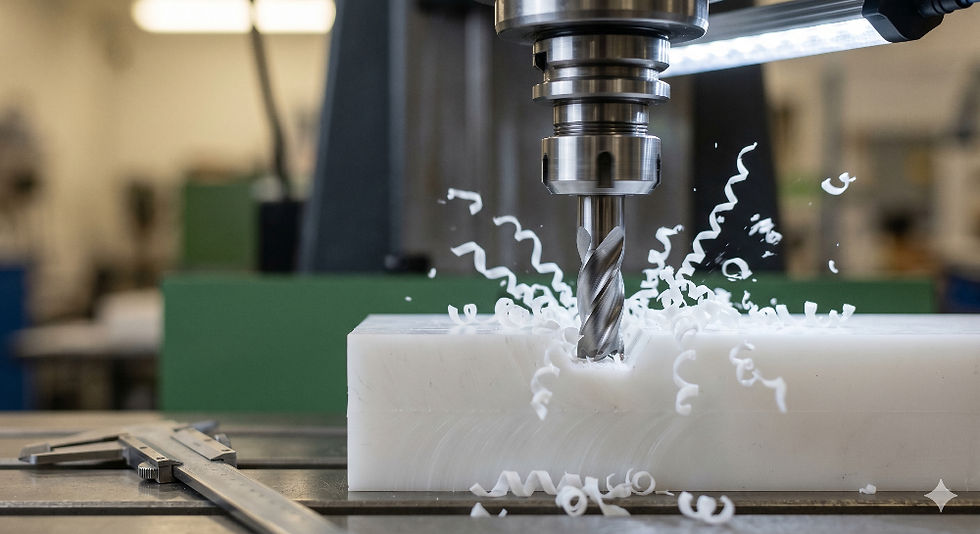
For parts that require CNC machining of plastic, in-house capability is particularly important. Plastic CNC machining requires specific tooling — single-flute or two-flute cutters, careful chip evacuation, often air or mist cooling rather than flood coolant and a shop that primarily machines metal will often produce poor results on plastic (melted edges, surface chattering, rough bore finishes).
A shop with one good CNC operator who machines plastic every day will outperform a large machine shop that treats plastic as an occasional job. Experience with the material matters more than machine count.
Check 3: Whether They Do DFM Reviews
Design for Manufacturability (DFM) is the practice of reviewing a customer's design before fabrication begins, flagging features that will be difficult, expensive, or impossible to produce to spec. A good fabricator does this automatically. A bad one quotes what you sent them, then calls you after cutting stock to say there's a problem.
DFM in plastic fabrication looks at things like: minimum wall thickness for the chosen material and process, internal corner radii that the cutter can physically achieve, weld joint design for structural strength, tolerances that are achievable vs unnecessarily tight, and features that would be cheaper to design differently.
This is especially critical if your design crosses processes — for example, a part that requires both CNC machining and hot-gas welding. Poor joint design at the weld line is one of the most common failure points in fabricated plastic assemblies. The DFM stage is where a good fabricator catches this before you've committed material.
If you're coming from an injection moulding background, the DFM criteria are different but the principle is the same — we've covered design for manufacturability in injection moulding in detail separately.
What good looks like: The fabricator sends back a short DFM note with your quote — listing any features they've adjusted and why, or flagging questions before cutting. It adds a day. It saves weeks.
Check 4: How They Actually Check Quality
Every fabricator will tell you they have quality control. The question is what that actually means in practice. "We check every part" is not a quality system. Ask for specifics.
What to look for:
Dimensional inspection tools they own and use — vernier callipers are baseline, but for precision work you want CMM (coordinate measuring machine) capability or at least a height gauge and surface plate setup.
First-article inspection process — do they measure the first part against drawing before running the full batch?
Visual inspection criteria — for finished parts, especially clear acrylic or display-grade plastics, you need defined acceptance criteria for surface scratches, edge chips, and weld discolouration.
Non-conformance process — what happens when a part fails inspection? Do they rework, scrap, or ship and hope you don't notice?
Quality failures in fabricated plastics often show up as dimensional drift across a batch (inconsistent clamping, tool wear), surface defects from wrong cutting parameters, or weld joint failures under load. If you've worked in injection moulding, you'll recognise the logic — common moulding defects and their root causes share the same underlying principle: most defects are process problems, not material problems, and a good shop knows which process variables cause which defects.
Check 5: Lead Times — And What They're Not Telling You
Quoted lead time and realistic lead time are rarely the same number. The gap between them tells you a lot about how honest a supplier is being with you.
Standard lead times for most fabricated plastic parts should be 3–10 working days from approved drawing. If a supplier is quoting 3–4 weeks for a straightforward machined and welded enclosure, they're either overloaded, not prioritising small orders, or farming the work out. All three of those are problems for a repeat-order relationship.
Ask: What's your current capacity? Where do my parts sit in your production queue? Do you have rush options, and what's the premium? Are lead times consistent across the year or do you have seasonal bottlenecks?
Production speed is partly a function of process efficiency — a shop that understands cycle time optimisation in any manufacturing context generally has tighter control over throughput. The same mindset that produces optimised moulding cycle times produces reliable fabrication lead times.
Red flag: A supplier who gives you a lead time without first seeing your drawing. Lead time depends entirely on complexity, material availability, and current workload. A supplier quoting "5–7 days" for a part they haven't seen yet is telling you nothing.
Check 6: Finishing and Post-Processing
A fabricated part that's dimensionally correct but has a rough edge, an unpolished weld line, or an untreated surface can still fail your requirements. Finishing is often the difference between a part that's technically correct and one that's actually acceptable to the end user or downstream assembly process.
Ask about:
Edge finishing — deburring, chamfering, flame polishing (for acrylic). Laser-cut acrylic edges can be polished to optical clarity in-house or left frosted depending on application.
Surface preparation — sanding grades, surface roughness achievable, preparation for adhesive bonding or paint.
Painting and marking — can they paint ABS or PVC? Do they offer UV printing or screen printing for component markings?
Assembly — can they deliver sub-assemblies, or do they supply individual parts only?
For parts involving multiple processes or materials — for example, a PC housing with overmoulded rubber grips — it's worth understanding the difference between insert moulding and overmoulding to determine whether fabrication or moulding is the right process for each element of the part.
Check 7 Minimum Orders and Prototyping Policy
This one is straightforward but frequently overlooked until it becomes a problem. Some fabrication shops won't take orders below a certain volume — either because their setup time doesn't justify a single-piece order, or because they've structured their business around production runs.
If you're in development, you need a fabricator who'll cut one piece as a prototype without charging you for a batch of twenty. The prototyping phase is where you find out whether your design actually works as intended — shrinkage, fit, assembly clearances, edge quality. A supplier who forces a minimum order on you during prototyping is the wrong supplier for development-stage work.
Also ask: if a material's dimensional properties affect my tolerances, can you advise upfront? For example, some plastics exhibit meaningful material shrinkage during and after processing, particularly on heated-formed parts. A supplier who understands material behaviour will flag this; one who doesn't will produce parts that are out of spec and not know why.
At Plast Fab Works, we work with single prototypes as standard.
5 Questions to Ask on the First Call
Before you send a drawing, these five questions will tell you most of what you need to know about a supplier's capability and honesty:
1. "What was the last part you made in [my specific material] and what was it for?"
Forces them to show specific experience rather than general claims. A fabricator who genuinely works in your material will answer this easily and in detail.
🚩 Red flag: vague answer, or "we can work with anything."
✅ Green flag: specific part description, material grade, application context.
2. "Can you walk me through your DFM process on a new enquiry?"
A supplier with a real DFM process will describe it specifically. A supplier who doesn't have one will give you a vague answer about "reviewing the drawing."
🚩 Red flag: "We just manufacture to your drawing."
✅ Green flag: "We send back a DFM note before quoting, flagging any features we'd recommend changing."
3. "What's your current lead time and how booked are you for the next three weeks?"
Honest suppliers answer this directly. Evasive ones give you a best-case lead time that doesn't reflect their current backlog.
🚩 Red flag: Instant "3–5 days" without asking about your part complexity.
✅ Green flag: "Currently running at [X] capacity, standard complex parts are [Y] days, simpler profiles are faster."
4. "What happens if a part fails your inspection?"
The answer reveals their non-conformance process and how they handle mistakes. Every shop makes mistakes. The difference is what they do about it.
🚩 Red flag: Hesitation, or "that doesn't happen."
✅ Green flag: Clear description of hold-rework-scrap decision process, with client notification.
5. "Can I visit the workshop or get a video call showing your machines?"
For any significant supplier relationship, seeing the physical setup tells you more than any website or sales call. Machine age, workshop cleanliness, and how operators handle materials are all visible signals.
🚩 Red flag: Refusal or excessive reluctance without a good reason.
✅ Green flag: Immediate offer to show you around. Confident suppliers are proud of their workshop.
If you're also evaluating whether fabrication is the right process at all — versus moulding, casting, or 3D printing — we've compared these across different volume ranges in our guide to plastic manufacturing techniques.
And if your project is leaning toward moulding and you want to understand the machine requirements, the injection moulding tonnage calculator is a useful tool to establish clamping force requirements before you approach suppliers. For background reading on the broader field, we've also compiled a list of the best mould design books worth having on your shelf.
Ready to Work With Fabricators Who'll Tell You the Truth?
Send us your drawing — we'll give you a DFM review with the quote, not after you've committed. No minimum order. Response within 24 hours.


Comments